The automotive landscape in India underwent a massive shift with the implementation of BS6 (Bharat Stage 6) emission standards. To meet strict environmental limits, commercial diesel vehicles, SUVs, and cars now come equipped with advanced exhaust treatment systems. Among these components, the Diesel Particulate Filter (DPF) plays the most vital role in trapping soot and harmful particulate matter.
However, frequent urban driving, stop-and-go traffic, and poor fuel quality cause these filters to clog rapidly. As a result, commercial vehicle owners face frequent engine power loss, reduced mileage, and costly filter replacements. This critical issue has created an enormous business opportunity for workshops, garages, and service stations across the country. Understanding how BS6 emission norms are driving the demand for a reliable DPF cleaning machine in India helps workshop owners upgrade their equipment and capture a highly profitable service market.
What Are BS6 Emission Norms and Why Did DPF Become Essential?
In April 2020, India bypassed BS5 entirely and moved directly from BS4 to BS6 emission standards. The primary goal was to drastically cut harmful pollutants from vehicle exhausts, particularly nitrogen oxides ($NO_x$) and fine particulate matter ($PM_{2.5}$ and $PM_{10}$).
To comply with these stringent regulations, automotive manufacturers introduced two key technologies in modern diesel engines:
- Selective Catalytic Reduction (SCR): Uses Diesel Exhaust Fluid (AdBlue) to reduce harmful $NO_x$ emissions into nitrogen and water vapor.
- Diesel Particulate Filter (DPF): A honeycomb structure inside the exhaust pipe that physically catches and traps soot particles before they exit into the atmosphere.
While the DPF is effective at curbing pollution, it accumulates soot over time. Under ideal long-distance driving conditions, the exhaust system reaches high temperatures ($500^\circ\text{C}$ to $600^\circ\text{C}$) to burn off the trapped soot naturally—a process known as passive regeneration. However, in typical Indian driving conditions, vehicles rarely sustain high speeds long enough for passive regeneration to work effectively.
Why DPF Clogging Is a Growing Issue in Indian Diesel Vehicles
Soot build-up in BS6 diesel engines is now one of the most common complaints among commercial fleet operators and private car owners in India. Several factors contribute to accelerated DPF blockage:
- Short Urban Trips: Delivery trucks, city buses, and passenger cars frequently operate in heavy city traffic where exhaust gas temperatures remain too low for passive soot burn-off.
- Fuel Quality Variations: Slight impurities or moisture in diesel lead to incomplete combustion, producing excessive carbon soot inside the exhaust line.
- Engine Oil Degradation: Using standard motor oil instead of low-SAPS (Sulphated Ash, Phosphorus, and Sulfur) oil clogs filter pores with non-combustible ash that active regeneration cannot burn away.
- Infrequent Active Regeneration: When automatic dashboard warnings appear, many drivers ignore forced regeneration alerts due to time constraints, leading to total filter saturation.
When a DPF becomes completely blocked, the vehicle enters “Limp Mode”—restricting engine speed and power to prevent engine damage. At this stage, manual intervention using a specialized DPF cleaning machine is the only safe and economical solution.
The Rise of DPF Cleaning Machines in the Indian Automotive Aftermarket
Replacing a damaged or clogged BS6 DPF unit is extremely expensive, often costing anywhere from ₹80,000 to over ₹2,500,000 depending on the vehicle size and make. For fleet operators, replacing filters frequently is financially unviable.
Cleaning the existing DPF unit restores original exhaust flow at a fraction of the replacement cost (typically 10% to 15% of the cost of a new filter). Consequently, auto workshops across Tier-1, Tier-2, and Tier-3 cities in India are investing in professional DPF cleaning systems to meet this surging demand.
+-----------------------------------------------------------------------+
|                       BS6 Emission Regulations                        |
+-----------------------------------------------------------------------+
                                    |
                                    v
+-----------------------------------------------------------------------+
|                    Mandatory DPF Integration                          |
+-----------------------------------------------------------------------+
                                    |
                                    v
+-----------------------------------------------------------------------+
|        Frequent Soot & Ash Accumulation in Urban Driving              |
+-----------------------------------------------------------------------+
                                    |
                                    v
+-----------------------------------------------------------------------+
|   Urgent Need for Professional Cleaning (vs. High Replacement Cost)   |
+-----------------------------------------------------------------------+
                                    |
                                    v
+-----------------------------------------------------------------------+
|        Surging Demand for DPF Cleaning Machines in Garages            |
+-----------------------------------------------------------------------+
Types of DPF Cleaning Machines Available in India
When setting up or upgrading a garage, selecting the right machine layout depends on your service volume, budget, and labor availability.
1. Fully Automatic DPF Cleaning Machines
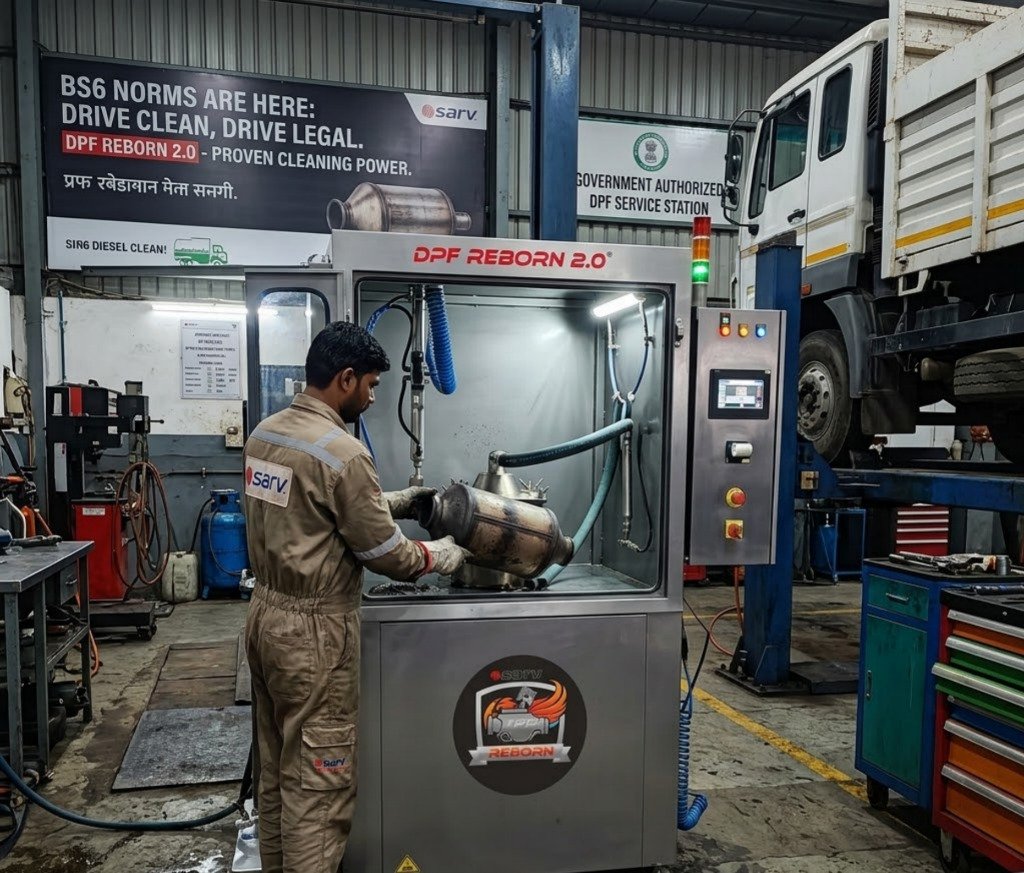
- Features: Touchscreen controls, automated washing cycles, built-in drying functions, and instant differential pressure testing before and after cleaning.
- Best For: Large service centers, commercial vehicle hubs, and dedicated DPF restoration centers.
- Benefits: Requires minimal operator supervision, minimizes human error, and delivers consistent cleaning cycles in under 60 minutes.
2. Semi-Automatic DPF Cleaning Machines
- Features: Manual loading, semi-automated fluid flushing, and external air-drying setups.
- Best For: Independent workshops and multi-brand garages entering the DPF repair space.
- Benefits: Highly cost-effective initial investment while maintaining high cleaning efficiency for light and heavy vehicles.
Looking to upgrade your workshop setup? Explore our range of [Fully Automatic and Semi-Automatic DPF Cleaning Machines] to boost your service capabilities.
Key Benefits of Investing in a DPF Cleaning Machine for Garage Owners
Adding a dedicated DPF washing system to your garage provides immediate business advantages:
- High Return on Investment (ROI): High demand for BS6 filter cleaning allows workshop owners to recover their initial equipment investment within 6 to 10 months.
- Faster Turnaround Time: Advanced machines clean and dry filters within 60 to 90 minutes, allowing you to service multiple vehicles daily.
- Verifiable Results: Integrated pressure sensors print diagnostic test receipts proving backpressure reduction and airflow restoration to customers.
- Environmentally Friendly Operations: Modern DPF cleaning equipment includes internal water filtration systems that collect trapped soot and ash without contaminating municipal drains.
How to Choose the Right DPF Cleaning Equipment in India
Before purchasing a DPF cleaning machine for your business, evaluate these vital technical aspects:
- Adapter Compatibility: Ensure the machine includes universal clamps and adaptors to fit small passenger car filters as well as large commercial truck catalysts.
- Built-in Drying System: High-volume hot air drying (at least $80^\circ\text{C}$–$100^\circ\text{C}$) is essential; reinstalling a damp filter causes rapid soot coagulation and immediate reclogging.
- Pressure Testing Capabilities: Built-in airflow meters allow you to measure backpressure in millibars ($mbar$) before and after the washing cycle.
- Manufacturer Support & Warranty: Partner with a supplier offering on-site installation, operator training, and ready availability of spare parts across India.
To learn more about national exhaust compliance standards and environmental testing procedures, review the guidelines published by theMinistry of Road Transport and Highways (MoRTH).
Conclusion
The shift to BS6 emission norms transformed DPF maintenance from an optional service into a daily necessity across India. As lakhs of BS6 commercial vehicles, buses, and private cars accumulate higher mileage, the frequency of clogged particulate filters will continue to rise.
For garage owners and automotive entrepreneurs, investing in professional DPF cleaning equipment is one of the most profitable upgrades available today. By providing reliable, fast, and cost-effective filter restoration, your workshop can build a loyal customer base while tapping into a rapidly growing market segment.
Ready to Expand Your Garage Business and Capitalize on the BS6 Service Demand?
Don’t let high-margin revenue walk past your workshop doors. Contact DPF Clean India today to explore our industry-leading Fully Automatic and Semi-Automatic DPF Cleaning Machines.
Schedule a live machine mo or request a free consultation with our technical specialists today!
Frequently Asked Questions (FAQs)
What is a DPF cleaning machine, and how does it work?
A DPF cleaning machine is a specialized industrial system designed to remove accumulated soot, carbon, and non-combustible ash from a Diesel Particulate Filter. It uses a combination of high-pressure liquid flushing, dedicated cleaning agents, and high-volume warm air drying to restore original exhaust airflow without damaging the delicate internal ceramic substrate.
Can a clogged BS6 DPF filter be cleaned at home or manually?
No, manual flushing with standard high-pressure water guns or harsh chemical sprays generally damages the internal ceramic structure or leaves moisture trapped inside the cell walls. Effective ash removal requires controlled fluid flow and complete thermal drying that only dedicated DPF cleaning equipment provides.
How often does a BS6 diesel vehicle need professional DPF cleaning?
In typical Indian city driving conditions, commercial vehicles and heavy-duty trucks usually require professional DPF cleaning every 40,000 km to 60,000 km. Passenger cars typically need service every 30,000 km to 50,000 km, or whenever active dashboard regeneration fails to clear persistent warnings.
How long does it take to clean a DPF using a machine?
Using a modern fully automatic DPF cleaning machine, the entire cycle—including backpressure testing, liquid flushing, chemical treatment, and high-temperature drying—takes approximately 60 to 90 minutes per filter.
What is the difference between active regeneration and machine cleaning?
Active regeneration burns off soft organic soot by raising exhaust temperatures during vehicle operation. However, it cannot burn away inorganic metallic ash caused by engine oil and fuel additives. A DPF cleaning machine physically flushes out both trapped soot and unburnable ash, fully restoring filter performance.