Modern diesel engines are built to deliver power, endurance, and fuel efficiency. However, strict emission norms (like BS6 Phase 2 and Euro 6) require advanced exhaust treatment systems. The heart of this system is the Diesel Particulate Filter (DPF).
If you own or manage a fleet of modern diesel vehicles, you have likely encountered DPF blockages. But did you know that not all blockages are created equal? The filter collects two distinct types of waste: Soot and Ash.
Understanding the difference between ash and soot is critical to picking the right dpf cleaning solution. Relying on simple chemical sprays won’t save a filter packed with non-combustible ash. In this comprehensive guide, we will break down the real enemy of your diesel engine, why standard regeneration fails over time, and how modern dpf cleaning techniques restore performance.
What is a Diesel Particulate Filter (DPF)?
A Diesel Particulate Filter is a specialized exhaust filter designed to capture harmful particulates before they leave your vehicle’s tailpipe. As diesel fuel burns, it releases particulate matter into the exhaust stream. The honeycomb-like structure inside the DPF traps these harmful particles, keeping the environment cleaner.
However, a DPF does not have unlimited capacity. Over time, trapped particles accumulate, restricting exhaust flow, increasing engine backpressure, and dropping fuel economy. To keep the engine running smoothly, this trapped waste must be removed.
What is Soot? (The Soft Enemy)
Definition and Origin
Soot is unburnt carbon residue generated during the incomplete combustion of diesel fuel. Whenever your engine runs under load, accelerates, or idle-burns fuel, soot is naturally produced and carried into the exhaust system.
How Soot Behaves
Soot is organic and combustible. Because it is carbon-based, soot can be burned off at high exhaust temperatures .
How Your Engine Handles Soot: Passive & Active Regeneration
Most modern diesel vehicles use Regeneration to clear soot automatically:
- Passive Regeneration: Occurs naturally when driving at high speeds on highways for 30–45 minutes. The exhaust reaches temperatures high enough to burn soot into a minor amount of gas and ash.
- Active Regeneration: Triggered by the vehicle’s ECU when soot accumulation reaches around 45–50%. Extra fuel is injected to artificially raise exhaust temperatures and incinerate the trapped carbon soot.
What is Ash? (The Permanent Enemy)
Definition and Origin
While soot comes from unburnt diesel fuel, ash originates primarily from metallic additives in engine lube oil, engine wear particles, and trace minerals in the fuel.
How Ash Behaves
Unlike soot, ash is non-combustible. It consists of inorganic materials like zinc, phosphorus, calcium, and sulfur.
Key Difference: No matter how hot your exhaust gets, or how many times your vehicle runs an active regeneration cycle, ash will never burn away.
The Problem with Cumulative Ash Build-up
Every time soot burns off during regeneration, a tiny residue of incombustible ash remains trapped inside the substrate cells of the DPF. Over 80,000 to 100,000 kilometers, this ash hardens into a concrete-like plug at the back of the filter channels.
As ash accumulation grows:
- Filter volume decreases.
- Exhaust backpressure rises permanently.
- Active regeneration triggers more frequently, wasting diesel fuel.
- The engine suffers from sluggish performance and potential turbo failure.
DPF Ash vs. Soot: A Direct Comparison
When comparing DPF Ash vs Soot, chemical additives only work on combustible carbon particles. Because ash is inorganic, no liquid spray can dissolve it out of the ceramic channels.
To make it simple, let us compare the key differences between these two engine pollutants:
| Feature | Soot | Ash |
| Origin | Incomplete combustion of diesel fuel | Engine oil additives, metallic wear, fuel impurities |
| Composition | Organic carbon particles | Inorganic metallic compounds (Calcium, Zinc, Phosphates) |
| Combustible | Yes (Burns above $550^\circ\text{C}$) | No (Cannot be burned off) |
| Removal Method | Passive / Active Regeneration | Machine-based dpf cleaning solution |
| Impact on DPF | Temporary blockages | Permanent volume loss & high backpressure |
Why Liquid Sprays and Chemical Additives Fail
When drivers notice a DPF warning light, many turn to off-the-shelf aerosol sprays or fuel tank additives labeled as a quick dpf cleaner.
While a chemical additive can lower the temperature required to burn soot, chemical sprays cannot dissolve or remove ash.
Here is why relying purely on chemical sprays can backfire:
- Ash remains trapped: Liquid cleaners loosen surface soot, but non-combustible ash remains packed tightly inside the filter cells.
- Thermal Shock Risk: Spraying chemical fluids incorrectly can cause thermal shock to the delicate ceramic honeycomb core, causing cracks.
- Short-Term Relief: The light may turn off for a few hundred kilometers, but because the physical ash volume was never reduced, the filter quickly blocks again.
To completely clear out compacted ash, you need a physical, mechanical dpf cleaning solution.
The Ultimate Fix: Professional Machine-Based DPF Cleaning
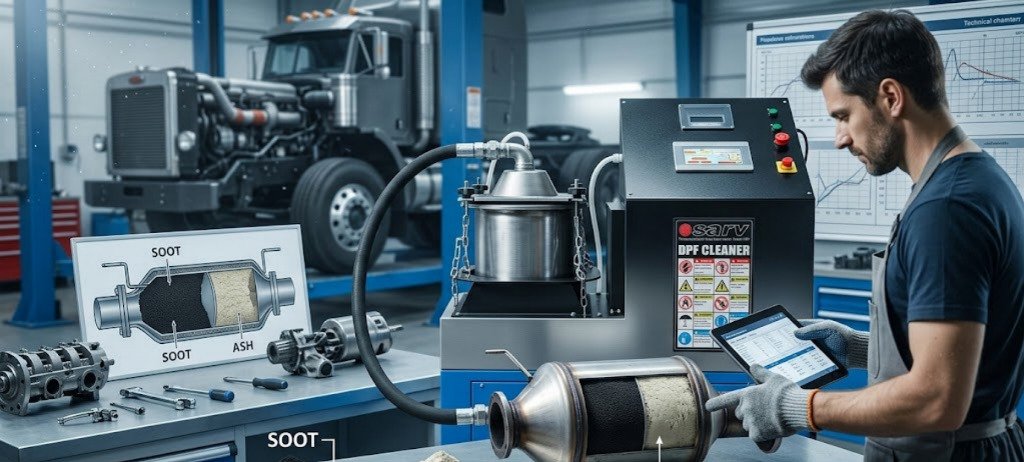
When ash builds up, the only effective resolution is removing the filter from the vehicle and placing it inside a dedicated dpf cleaning machine.
[Vehicle DPF Blockage] ➔ [Remove DPF] ➔ [Pneumatic Air Blow] ➔ [Hydro-Dynamic Machine Flush] ➔ [Drying] ➔ [100% Restored Flow]


Modern aqueous flushing systems use controlled water pressure, air pulses, and specialized non-corrosive washing agents to flush trapped ash and hardened soot particles out in the opposite direction of normal exhaust flow.
Benefits of Machine Cleaning:
- Removes Non-Combustible Ash: Fully clears both soot and stubborn ash deposits.
- Restores OEM Airflow: Returns backpressure readings back to near-factory levels (up to 98% clean).
- Extends DPF Lifespan: Avoids expensive replacement costs for new original filters.
- Saves Fuel: Reduces frequent unwanted regenerations, instantly improving mileage.
Modern Automatic DPF Cleaning Machine Models
How to Prevent Rapid DPF Clogging
While professional cleaning is inevitable over time due to ash buildup, you can slow down the rate of accumulation with these maintenance habits:
- Use Low-SAPS Engine Oil: Low-SAPS (Sulfated Ash, Phosphorus, and Sulfur) oils are engineered specifically for modern BS6 / Euro 6 engines with particulate filters to minimize ash residue.
- Avoid Excessive Idling: Long periods of idling cause incomplete fuel combustion, creating massive amounts of soot at low temperatures.
- Drive on Highways Regularly: Allow your vehicle to run at sustained highway speeds (above 2000 RPM) every few weeks to encourage natural passive regeneration.
- Fix Engine Malfunctions Early: Leaking fuel injectors, a stuck EGR valve, or faulty turbochargers increase soot production dramatically.
Authority Resources
To understand more about environmental regulations, engine maintenance, and technical standards, explore these authoritative resources:
- Learn more about international emissions standards at the U.S. Environmental Protection Agency (EPA).
- Technical literature on diesel particulate filters and fluid dynamics on SAE International.
Conclusion
Understanding the debate of DPF Ash vs Soot is vital for long-term engine health. Soot can be burned away naturally through vehicle regeneration, but non-combustible ash requires dedicated machine cleaning.
Soot may be the most common cause of short-term DPF issues, but ash is the real long-term enemy of your diesel engine. While soot can be burned away naturally through vehicle regeneration, non-combustible ash requires a dedicated mechanical intervention.
Using temporary liquid sprays will only mask the problem. To truly safeguard your engine, lower operating costs, and restore fuel economy, investing in a professional dpf cleaning machine in india or servicing your filter with a certified machine-based dpf cleaning solution is essential.
Is Your Diesel Vehicle Losing Power or Showing a DPF Light?
Don’t let stubborn ash ruin your engine or drain your wallet on frequent replacements! Explore our state-of-the-art dpf cleaning machine range and professional service solutions designed to restore your DPF performance to near 100%.
Contact Our Technical Experts Today or Visit our workshop to get an airflow backpressure test!
6. Frequently Asked Questions (FAQs)
What is the main difference between soot and ash in a DPF?
Soot is unburnt organic carbon from fuel that can be burned off during high temperature regeneration. Ash comes from engine oil additives and metal wear. It is incombustible and cannot be burned off, requiring machine cleaning for removal.
Can I clean DPF ash using fuel additives or aerosol sprays?
No. Fuel additives and chemical sprays only help burn off carbon soot at lower temperatures. They cannot dissolve or flush out non-combustible metallic ash packed inside the filter.
How often does a DPF need professional machine cleaning?
For passenger vehicles and light commercial trucks, a professional machine based cleaning is typically recommended every 80000 to 100000 kilometers, or whenever persistent backpressure issues occur.
Will a clogged DPF damage my engine?
Yes. Severe exhaust backpressure caused by a clogged DPF can lead to turbocharger damage, decreased fuel efficiency, overheating, and potential engine failure.