Diesel particulate filters (DPFs) are vital components in modern commercial and passenger diesel vehicles. Over time, soot, unburned fuel, and non-combustible ash build up inside the honeycomb structure, reducing engine efficiency and causing severe backpressure. Fleet operators and garage owners constantly search for the most efficient dpf cleaning solution to restore these expensive filters to OEM standards.
When choosing a dpf cleaner method, the market primarily divides into two methods: manual chemical soaking and fully automated machine cleaning. Understanding which dpf cleaning method delivers long-term performance without causing structural damage is critical for extending engine life and lowering maintenance costs.
What Is a DPF and Why Does It Clog?
A Diesel Particulate Filter traps harmful soot emissions before they exit the tailpipe. While high-temperature passive or active regeneration burns off trapped soot during normal highway driving, ash remains behind. Ash cannot burn off naturally and eventually chokes the filter cells.
       [ Exhaust Flow ] ───► [ Soot & Ash Accumulation ] ───► [ Backpressure Rises ]
                                                                       │
[ OEM Performance Restored ] ◄─── [ Deep Cleaning Method Applied ] ◄───┘
When ash buildup reaches critical levels, passive regeneration fails. Leaving ash unresolved causes engine fault codes, limp mode, and severe fuel inefficiency. A professional restoration process becomes unavoidable.
Method 1: Manual Chemical Bath (Soaking)
Manual chemical cleaning involves submerging the clogged filter into a chemical solvent bath to break down trapped soot and carbon buildup.
How Manual Soaking Works
- Dismounting: Mechanics remove the filter from the exhaust line.
- Soaking: The unit is soaked in solvent for several hours or overnight.
- Manual Flushing: Mechanics rinse the filter channels using high-pressure water hoses.
- Drying: The filter air-dries before reinstallation.
Advantages of Manual Soaking
- Low Initial Investment: Requires simple wash tubs and chemical solutions rather than high-end machinery.
- Simple Setup: Minimal technician training required to start soaking parts.
Disadvantages and Limitations
- Incomplete Ash Removal: Chemical solvents soften soot, but they cannot effectively dislodge heavy non-combustible ash trapped deep inside closed ceramic cells.
- Risk of Thermal / Chemical Shock: Aggressive chemical formulas can weaken internal ceramic cell walls or degrade precious metal catalysts (platinum/palladium).
- Environment & Safety Risks: Handling and disposing of toxic spent chemical solutions creates severe environmental compliance hazards.
- Long Downtime: Soaking and drying cycles take anywhere from 12 to 24 hours per unit.
Method 2: Automated DPF Cleaning Machine
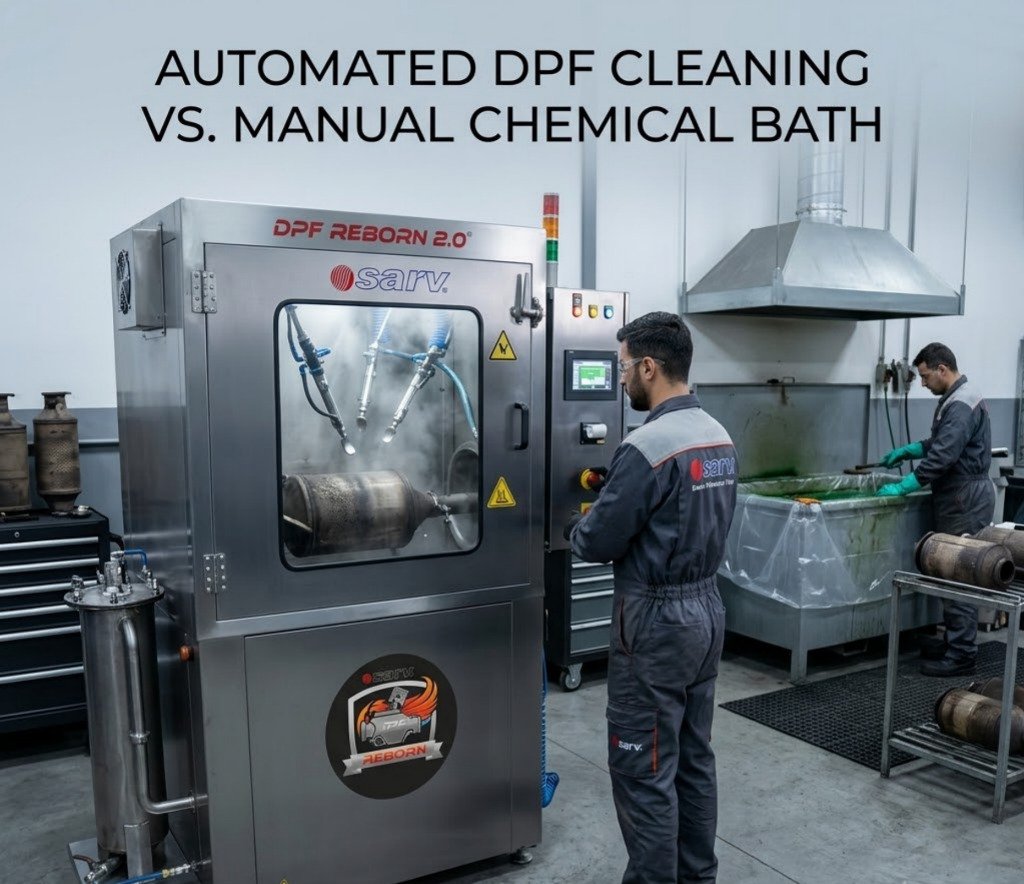
Automated hydro-pneumatic and thermal cleaning systems represent modern, precision-engineered filter restoration technology.
+-----------------------------------------------------------------------+
|                    AUTOMATED DPF CLEANING CYCLE                      |
|                                                                       |
|  [ Backpressure Test ] ──► [ Hydro-Pneumatic Wash ] ──► [ Air Dry ]   |
|         (Pre)                  (Aqueous Solution)         (Drying)    |
|                                                                  │    |
|  [ OEM Performance Verified ] ◄── [ Backpressure Test ] ─────────┘    |
|                                         (Post)                        |
+-----------------------------------------------------------------------+
How an Automated DPF Cleaning Machine Works
- Initial Testing: High-precision differential pressure sensors measure clogged airflow to set a baseline.
- Dual-Action Washing: The filter is mounted inside a closed cabinet. Alternating high-pressure water pulses and proprietary aqueous dpf cleaning solution flush out trapped ash in both directions.
- Controlled Air Drying: Integrated heating elements dry internal cells rapidly without thermal shock risks.
- Final Verification: Post-cleaning pressure tests compare current airflow directly against OEM factory parameters.
Advantages of Automated Machines
- Complete Ash Removal: Hydro-pneumatic force removes up to 98% of soot and ash buildup.
- Fast Turnaround: Complete washing and drying cycles take under 60–90 minutes per filter.
- Safe for Catalysts: Pure aqueous washing combined with targeted biodegradable fluids protects internal substrate coatings.
- Closed-Loop Filtration: Contaminated wash water passes through internal multi-stage filtration units before recirculation, protecting the shop environment.
- Printable Proof of Performance: Automated sensors print pre- and post-cleaning test reports to show clients verified backpressure reduction.
Disadvantages
- Higher initial capital investment compared to basic wash tubs.
Head-to-Head Comparison: Automated vs. Manual Bath
| Comparison Feature | Manual Chemical Bath | Automated DPF Cleaning Machine |
| Ash Removal Efficiency | 40% – 60% (Surface & Soot only) | Up to 98% (Soot + Deep Ash) |
| Cleaning Cycle Time | 12 to 24 Hours | 45 to 90 Minutes |
| Risk to Ceramic Honeycomb | High (Corrosive solvents) | Very Low (Controlled fluid pulses) |
| Verification / Testing | Visual / Manual Inspection | Digital Pre & Post Pressure Diagnostics |
| Environmental Safety | High toxic wastewater volume | Closed-loop internal filtration |
| Return on Investment (ROI) | Low long-term value | High throughput & rapid shop payback |
Impact on Filter Lifespan and Engine Performance
Using an inadequate method like chemical soaking often leaves hard ash deposits baked inside internal channels. Residual ash causes backpressure to rise quickly after reinstallation, leading to frequent regeneration cycles and shortened filter life.
An automated dpf cleaning machine uses directional liquid bursts to push ash back out through cell entrances. Clearing those passages restores exhaust flow back to OEM levels, improving fuel efficiency, reducing turbo pressure loss, and extending filter life by years.
Automated equipment is rapidly replacing traditional methods across workshop hubs in Europe, the US, and growing automotive service markets across Asia. Investing in an automated dpf cleaning machine in india allows commercial fleet hubs and modern workshops to lower cost-per-kilometer metrics while keeping heavy vehicles fully emission-compliant.
Reference official vehicle emission standards and filter testing benchmarks from authority sources such as the U.S. Environmental Protection Agency (EPA) or local automotive compliance portals.
Conclusion
Manual chemical baths may offer a low initial setup cost, but their long cycle times, incomplete ash removal, and potential catalyst damage make them unsuitable for high-volume commercial service.
Automated hydro-pneumatic machine systems provide verified backpressure restoration, fast turnaround times, and safe handling for sensitive ceramic substrates. Selecting high-grade automated equipment ensures long filter life, reduced vehicle downtime, and measurable shop performance.
Ready to Upgrade Your Filter Maintenance Capabilities?
Equip your workshop with industry-leading, high-efficiency equipment. [Contact Our DPF Cleaning Specialists Today] to request a live demo, explore machine specifications, and find the perfect cleaning equipment for your business!
Frequently Asked Questions (FAQs)
Yes. Harsh acid- or solvent-based chemical baths can erode sensitive precious metal coatings (platinum/palladium) on the ceramic honeycomb and cause structural degradation over time.
Commercial diesel vehicles typically require deep professional ash removal every 100,000 to 150,000 kilometers, depending on duty cycles and fuel quality.
Yes. Hydro-pneumatic automated machines use alternating fluid and air pressure cycles to dislodge and flush out hard, non-combustible ash that thermal regeneration cannot burn away.
A full automated cleaning cycle—including pre-testing, bi-directional aqueous flushing, heated air drying, and final backpressure diagnostics—takes between 45 and 90 minutes.