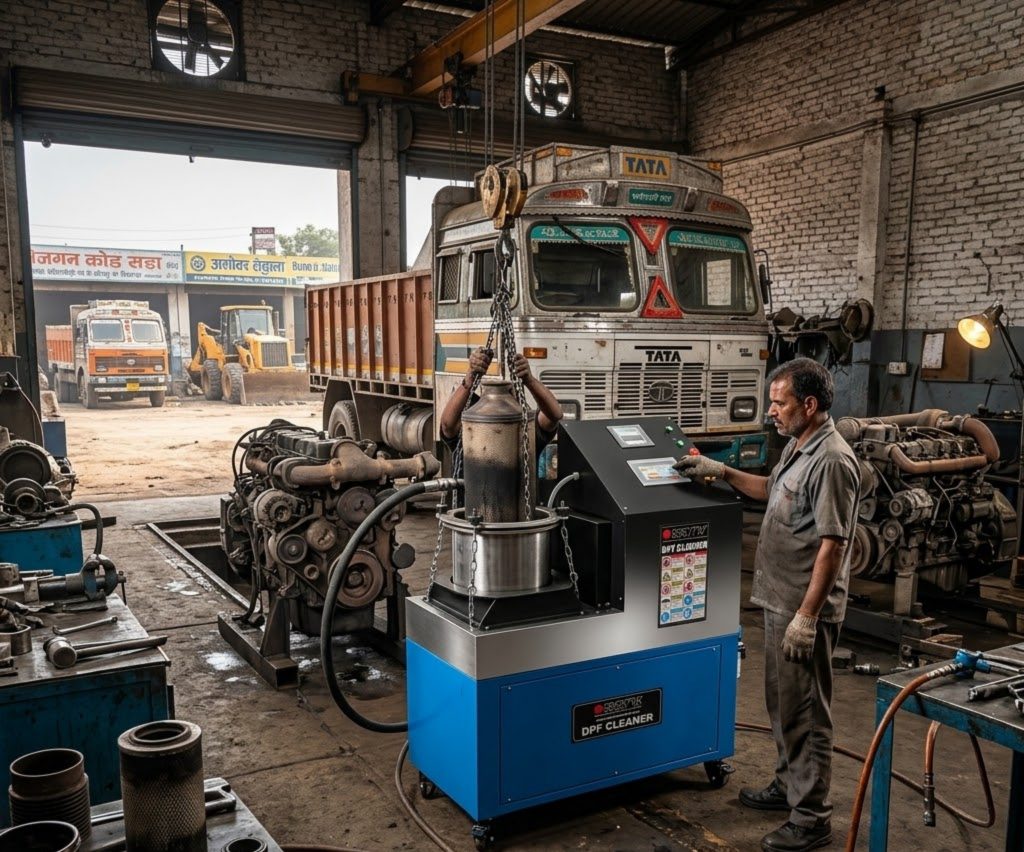
Heavy-duty commercial vehicles and diesel generators across India operate under tough road conditions, high dust levels, and continuous heavy loads. Over time, soot and unburned ash accumulate inside the Diesel Particulate Filter (DPF), restricting exhaust flow and choking engine output. Implementing a reliable dpf cleaning solution is critical to maintaining operational efficiency, complying with Bharat Stage VI (BS6) emission norms, and avoiding costly replacements. Using an advanced ultrasonic dpf cleaning machine ensures deep, non-destructive restoration of clogged filters, allowing fleet owners and workshop operators to maximize engine longevity.
Understanding the DPF Cleaning Solution Challenge in Heavy-Duty Vehicles
A Diesel Particulate Filter is designed to capture harmful particulate matter (PM) or soot from diesel engine exhaust. In modern BS6-compliant commercial vehicles, buses, construction equipment, and industrial generators, the DPF plays an indispensable role in meeting environmental regulations.
+---------------------------+---------------------------------------------------------+
| Operating Condition       | Impact on Diesel Particulate Filter                     |
+---------------------------+---------------------------------------------------------+
| Frequent Stop-and-Go      | Prevents passive regeneration; accelerates soot buildup |
| Low-Speed Running         | Insufficient exhaust gas temperatures to burn off ash   |
| High-Sulfur Diesel Fuel   | Increases chemical residues and unburned particulates   |
| Extended Idle Hours       | Causes heavy carbon crusting inside ceramic channels   |
+---------------------------+---------------------------------------------------------+
While passive and active on-vehicle regeneration burn away soft soot, non-combustible ash stays trapped inside the honeycomb micro-channels. Over months of operation, this blockage reduces backpressure limits, reduces fuel economy, and eventually triggers engine limp mode.
What Makes Ultrasonic Cleaning Superior to Traditional Methods?
Historically, mechanics used manual back-flushing, harsh chemical soaking, or high-pressure air blowing to unclog filters. These outdated techniques often leave deep internal channels blocked or cause permanent structural cracking to delicate ceramic walls.
1. Cavitation Technology for Deep Restoration
An ultrasonic DPF Cleaning Solution uses high-frequency sound waves propagated through a specialized aqueous dpf cleaning fluid. These sound waves generate microscopic vacuum bubbles that implode against internal filter surfaces—a process known as cavitation.
- Micro-scale Precision: Cavitation micro-explosions reach deep into honeycomb passages that pressurized air or thermal baking cannot access.
- Gentle on Substrates: The process removes baked-on ash and stubborn carbon without abrasive mechanical wear or thermal shocks.
- Uniform Decontamination: Liquid medium penetrates all cell walls evenly, restoring up to 98% of original exhaust flow.
Key Benefits of Using an Advanced DPF Cleaning Machine in India
Investing in a high-performance dpf cleaning machine in india provides substantial financial and operational advantages for workshops, transport fleets, and industrial equipment operators.
                  [ Ultrasonic DPF Cleaning Workflow ]
                                    │
                                    ▼
                     ┌─────────────────────────────┐
                     │  Backpressure Diagnostics   │
                     └──────────────┬──────────────┘
                                    │
                                    ▼
                     ┌─────────────────────────────┐
                     │ High-Frequency Ultrasonic   │
                     │  Cavitation Bath & Solution │
                     └──────────────┬──────────────┘
                                    │
                                    ▼
                     ┌─────────────────────────────┐
                     │ Controlled Drying & Final   │
                     │ Flow Testing Certification  │
                     └─────────────────────────────┘
Reduced Operating Costs and Zero Down-Time Loss
Replacing a commercial-grade heavy-duty DPF filter can cost anywhere from ₹80,000 to over ₹3,000,000 depending on machine size and vehicle capacity. Regular maintenance using a specialized dpf cleaning solution restores original flow dynamics at a fraction of the cost of a brand-new assembly.
Compliance with BS6 Emission Standards
India’s stringent BS6 emissions framework mandates strict monitoring of particulate emissions. A clogged or bypassed filter leads to failed road inspections, heavy fines, and immediate vehicle grounding. Deep cleaning ensures your fleet consistently complies with Central Pollution Control Board (CPCB) standards.
Restored Fuel Efficiency and Engine Horsepower
When exhaust backpressure rises beyond safe operating limits, the engine expends excess energy simply pushing exhaust gases out. Cleaning the filter reduces backpressure instantly, restoring baseline power delivery and improving diesel mileage.
Comparing DPF Maintenance Techniques
+-----------------------+---------------------+----------------------+---------------------+
| Feature               | Compressed Air Blow | High-Heat Thermal    | Ultrasonic Machine  |
+-----------------------+---------------------+----------------------+---------------------+
| Ash Removal Depth     | Surface Only        | Partial (Soft Soot)  | Complete (Deep Cell)|
| Risk of Ceramic Damage| High (Cracking)     | High (Thermal Stress)| Very Low            |
| Process Time          | 30-45 Mins          | 8-12 Hours           | 60-90 Mins          |
| Eco-Friendliness      | Poor (Dust Leak)    | High Carbon Footprint| Sealed Fluid Recirc |
+-----------------------+---------------------+----------------------+---------------------+
Step-by-Step Ultrasonic DPF Restoration Process
A professional restoration protocol involves several essential steps to ensure safety and performance validation:
- Initial Inspection and Differential Pressure Test: Measure baseline air resistance and check ceramic monolith structure for thermal fractures or melting.
- Ultrasonic Immersion: Place the filter unit into the ultrasonic tank filled with biodegradable, non-corrosive chemical agent.
- High-Frequency Cavitation: Run ultrasonic transducers for 45 to 60 minutes to break down hardened ash deposits and oily carbon crusts.
- Controlled Reverse Rinsing: Flush detached particles from channels using regulated water flow.
- Hot Air Drying and Final Airflow Certification: Dry the unit using temperature-controlled air cycles and perform a post-cleaning pressure test to verify full recovery.
Selecting the Right Equipment for Workshop Success
When choosing a dpf cleaning solution in india, garage owners and service centers should evaluate essential operational specifications:
- Tank Capacity: Ensure the cleaning basin is large enough to handle heavy commercial bus, truck, and generator filters.
- Transducer Quality: High-grade industrial piezo-ceramic transducers provide uniform power distribution throughout the fluid tank.
- Fluid Filtration and Recycling: Integrated dual-stage filtration systems capture removed sludge and extend liquid service life.
- Built-in Pressure Diagnostics: Integrated flow sensors allow operators to provide printed before-and-after performance reports to customers.
Link to official emission regulatory guidelines or industry standards, such as the Central Pollution Control Board (CPCB India) for information on BS6 commercial vehicle compliance standards.
Heavy-duty commercial engines require optimal exhaust flow to perform reliably under demanding Indian conditions. Utilizing an advanced ultrasonic dpf cleaning solution protects valuable engine components, restores fuel mileage, and ensures hassle-free compliance with national emission regulations. Upgrading your service center with modern cleaning technology reduces customer maintenance costs while creating a high-margin revenue stream for your business.
Ready to upgrade your workshop with industry-leading cleaning technology? Discover high-performance cleaning solutions engineered for maximum efficiency. [Explore Our DPF Cleaning Machines Today] or speak with our technical team to request a live equipment demonstration!
Frequently Asked Questions (FAQs)
How often does a heavy-duty BS6 vehicle DPF require cleaning?
Heavy-duty commercial vehicles typically require professional cleaning every 100,000 to 150,000 kilometers, depending on duty cycle, fuel quality, and driving conditions.
Can ultrasonic cleaning damage the internal filter structure?
No. Ultrasonic cleaning uses gentle fluid cavitation to lift ash without abrasive force, thermal shock, or high-pressure mechanical impact, making it safe for delicate ceramic substrates.
How long does the ultrasonic DPF cleaning process take?
A complete cleaning cycle—including pre-testing, ultrasonic bath, flushing, drying, and final flow verification—generally takes between 1.5 to 2.5 hours.
Why isn’t passive on-road regeneration sufficient for long-term maintenance?
Passive regeneration burns soft soot into carbon dioxide, but non-combustible metallic ash remains trapped inside filter cells. Over time, physical fluid cleaning is required to remove this accumulated ash.