Modern diesel vehicles depend heavily on Diesel Particulate Filters (DPF) to control exhaust emissions.To keep engines running efficiently need to avoid some dpf cleaning solution mistakes. As a workshop owner, offering a reliable dpf cleaning solution allows you to deliver high-value service to your customers. However, cleaning these delicate filters requires precision, the correct equipment, and chemical awareness. Many garage owners unknowingly make critical errors during the dpf cleaning process, which can permanently damage expensive filters, ruin customer trust, or result in repeat complaints.
Investing in a high-grade dpf cleaner or a specialized dpf cleaning machine is only half the battle. Understanding proper procedures ensures long-term filter health and protects your workshop’s reputation.
Below are the top 5 mistakes workshop owners make while cleaning DPF filters and actionable steps to avoid them.
1. Using Harsh or Unapproved Chemical Cleaners
One of the most common mistakes in commercial workshops is using generic degreasers, harsh acids, or unapproved chemical solvents to clear blocked filters.
Why Generic Chemicals Fail
- Substrate Damage: The internal honeycomb structure of a DPF is made of silicon carbide or cordierite coated with precious metals (platinum, palladium, rhodium). Harsh acids strip away these catalytic coatings.
- Thermal Shock: Non-specialized liquid solutions can cause extreme temperature spikes or chemical reactions inside the filter, leading to cracks in the ceramic core.
- Residual Buildup: Cheap chemical alternatives often leave sticky residues behind. Once the engine reaches high temperatures, these residues bake onto the filter wall, causing faster re-blocking.
The Correct Approach
To avoid dpf cleaning solution mistakes, Always use a specialized, certified dpf cleaning solution designed specifically for automotive soot and ash removal. Proper solutions gently break down stubborn carbon deposits without stripping essential catalytic coatings or weakening the ceramic core.
2. Neglecting Pre-Diagnostic and Inspection Protocols
Jumping straight into cleaning a DPF without checking the overall engine health is a costly mistake. A blocked DPF is almost always a symptom of an underlying mechanical issue, not the root cause.
What Happens When You Skip Inspection?
- Wasted Labor: If an engine has bad fuel injectors, a failing turbocharger, or a faulty EGR valve, the newly cleaned DPF will block again within a few hundred kilometers.
- Cleaning Damaged Filters: Attempting to clean a filter that already has melted substrate or internal structural cracks will fail, leading to customer dissatisfaction.
Essential Pre-Cleaning Steps
- Diagnostic Scan: Read live engine data for fault codes related to sensors, differential pressure, EGR systems, and fuel delivery.
- Borescope Visual Check: Inspect the interior structure of the filter for physical cracks, melting, or heavy oil contamination from turbo leaks.
- Backpressure Testing: Measure pressure drops before starting the cycle to establish a clear baseline.
3. Relying Solely on Chemical Soaking Without Automated Flow Control
Soaking a filter in a drum of liquid cleaner and rinsing it with a standard pressure washer is an outdated method that rarely yields consistent results.
The Limits of Manual Rinsing
- Uneven Flow: Manual pressure washing cannot clear deep ash pockets trapped in the narrow internal channels.
- Trapped Moisture: Incomplete rinsing leaves dirty residue behind, which dries into a cement-like block inside the channels once installed back on the vehicle.
Upgrade to Professional Equipment
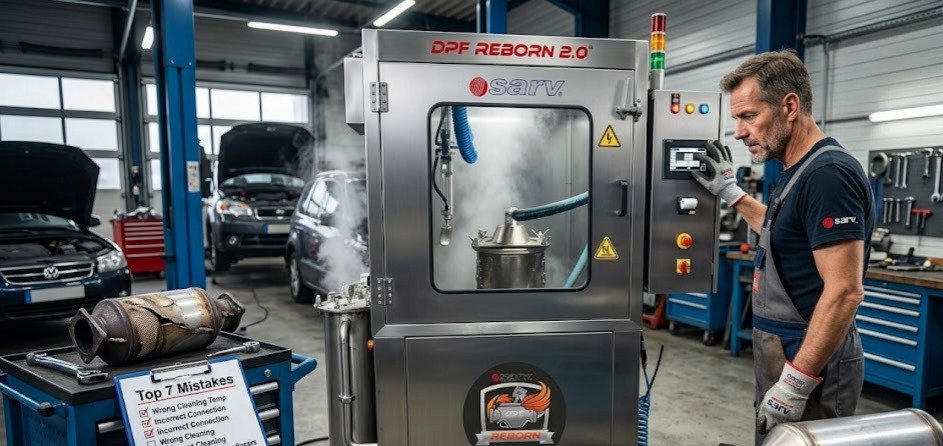
To deliver factory-level results, workshops should transition to an automated dpf cleaning machine. Modern machines combine aqueous flush cycles, controlled pressure surges, and air-impulse technologies to push trapped ash out from both directions.
For commercial garages looking to scale operations, investing in an advanced dpf cleaning machine in india provides precise flow control, closed-loop filtration, and automated drying cycles that manual methods simply cannot match.
4. Skipping the Complete Drying Phase
Reinstalling a DPF while it is still damp internally is a recipe for instant failure.
Dangers of Moisture Inside the DPF
- Ash Cementation: Remaining moisture mixes with soot particles upon engine start-up, creating a sludge that bakes hard and blocks air passages completely.
- Thermal Cracking: Hot exhaust gases hitting cold water trapped inside the ceramic substrate cause rapid thermal expansion, fracturing the core.
- Sensor Damage: Excess water vapors blown downstream can ruin delicate exhaust gas temperature (EGT) and differential pressure sensors.
Best Drying Practices
- Use a high-volume hot-air drying system attached to your cleaning station.
- Ensure internal temperatures remain controlled during drying to avoid thermal shock.
- Measure differential pressure again after the drying phase to confirm complete moisture removal.
5. Failing to Reset the ECU and Educate the Vehicle Owner
The cleaning process does not end when the filter is reinstalled on the vehicle. Two final steps are crucial for long-term success: resetting vehicle adaptation values and educating the driver.
Resetting Engine Adaptation Values
Modern Vehicle Control Units (ECUs) estimate soot load based on algorithms and pressure sensors. If you clean the physical filter but fail to reset the learned soot values using a diagnostic tool, the ECU will continue operating under the assumption that the DPF is full. This can trigger unnecessary active regenerations or keep the vehicle in limp mode.
Customer Education Checklist
- Explain the importance of using low-SAPS engine oil.
- Advise customers against frequent short trips that prevent passive regeneration.
- Highlight early warning signs of engine components (like EGR valves) that contribute to rapid soot accumulation.
Comparison to avoid dpf cleaning solution mistakes : Manual Cleaning vs. Professional Machine Cleaning
| Feature | Manual Soaking & Rinsing | Automated DPF Cleaning Machine |
| Ash Removal Efficiency | Low (30% – 50%) | High (95% – 99%) |
| Cleaning Time | 6 – 12 Hours | 45 – 90 Minutes |
| Substrate Safety Risk | High (Uncontrolled pressure/chemicals) | Low (Controlled pressure & temp) |
| Drying Capabilities | Air drying (Incomplete) | Integrated Hot Air Drying |
| Environmental Safety | High risk of dirty runoff | Closed-loop fluid filtration |
For detailed regulatory emission standards, refer to official updates on BS-VI Emission Norms by the Ministry of Road Transport and Highways.
Conclusion
Cleaning DPF filters is a highly profitable service for modern workshops, but shortcuts lead to damaged components and dissatisfied clients. By switching to a certified dpf cleaning solution, inspecting filters thoroughly before cleaning, using a dedicated dpf cleaner setup, and ensuring complete drying, you can guarantee superior results every time. Modernizing your garage with a high-performance dpf cleaning machine in india ensures safety, efficiency, and long-term business growth.
Ready to Upgrade Your Workshop’s DPF Cleaning Capability?
Stop risking filter damage with outdated manual methods. Upgrade your workshop with our industry-grade DPF cleaning machines and eco-friendly cleaning solutions today.
👉 [Contact Our Experts Today] for a free product demonstration and custom quote for your garage!