Finding an effective Best DPF Cleaning Solution India has become a top priority for fleet managers, garage owners, and commercial vehicle operators across India. Ever since the nationwide implementation of BS6 (Bharat Stage 6) emission norms, Diesel Particulate Filters (DPF) have become a standard component in modern diesel engines.
However, Indian driving conditions present unique challenges: heavy stop-and-go traffic, adulterated fuel, extended idling, and high ambient temperatures. These factors cause DPFs to clog much faster than in Western countries.
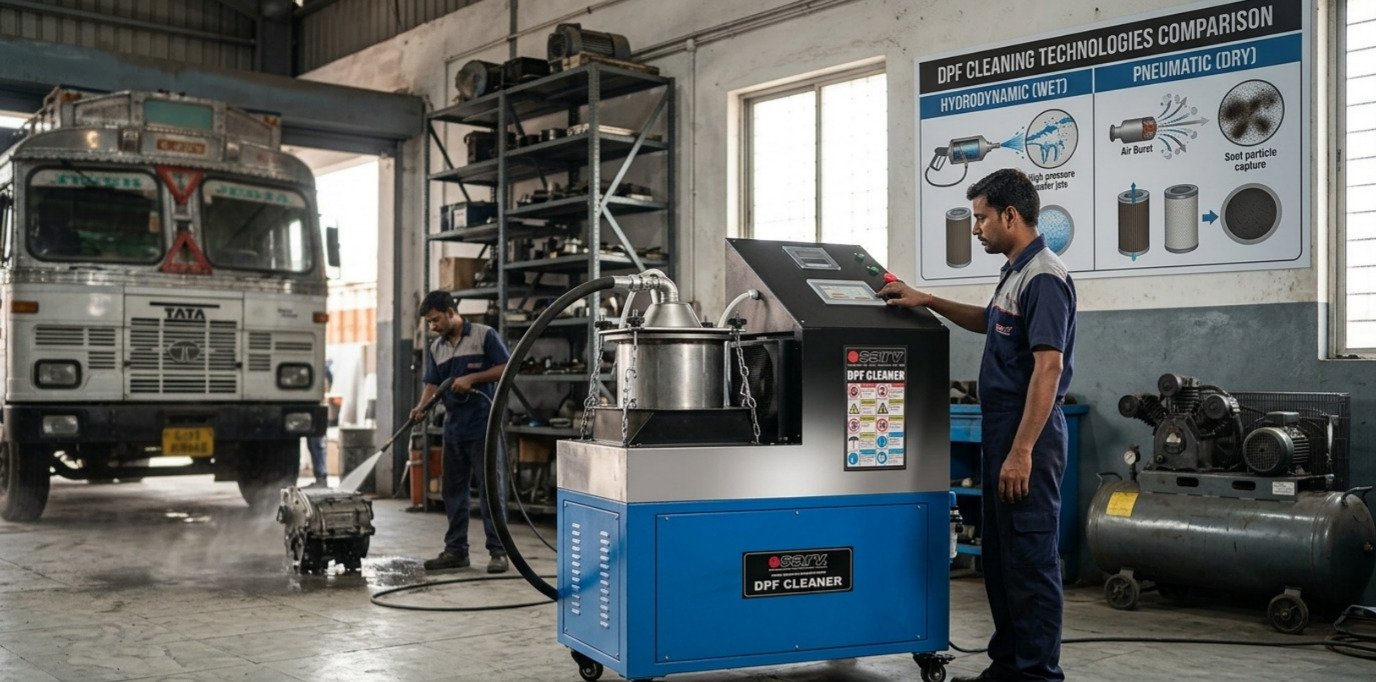
When choosing a professional DPF cleaning machine, service centers generally evaluate two main technologies: Hydrodynamic (water-based) cleaning and Pneumatic (air-based) cleaning. But which technology truly excels under Indian operating conditions? Let’s evaluate both to help you make an informed decision.
Understanding BS6 Norms and the Indian DPF Problem
Before diving into machine technologies, it is essential to understand why DPF cleaning is in such high demand across India.
+-----------------------------------------------------------------------+
|                       THE DPF CLOGGING CYCLE                          |
|                                                                       |
|   [ Indian Road Conditions ] -> Stop-and-go, heavy load, poor fuel    |
|                                    │                                  |
|                                    ▼                                  |
|   [ Incomplete Combustion ]  -> Generates excess soot and ash          |
|                                    │                                  |
|                                    ▼                                  |
|   [ Passive Regen Fails ]    -> Exhaust temp stays below ~550°C       |
|                                    │                                  |
|                                    ▼                                  |
|   [ Filter Clogging ]        -> Increased backpressure, power drop    |
+-----------------------------------------------------------------------+
A Diesel Particulate Filter traps soot (unburnt carbon) and ash (mineral deposits from engine oil). During high-speed highway driving, passive regeneration burns off accumulated soot automatically.
However, Indian driving conditions disrupt this natural process:
- Frequent City Traffic: Low engine speeds prevent exhaust gases from reaching the required $500^\circ\text{C} – 600^\circ\text{C}$ burn-off temperature.
- Low-Quality or Adulterated Fuel: Produces higher particulate matter, clogging filters prematurely.
- High Ash Accumulation: Unlike soot, lubricant-derived ash cannot be burned off during regeneration and must be physically removed using a specialized dpf cleaner.
When backpressure increases beyond acceptable limits, forced manual regeneration fails, making mechanical cleaning with a dedicated Best DPF Cleaning Solution India the only viable solution short of expensive replacement.
What is Hydrodynamic DPF Cleaning Technology?
Hydrodynamic cleaning, often referred to as wet cleaning or hydraulic flush cleaning, uses a combination of water, specialized eco-friendly chemical solvents, and controlled hydrostatic pressure pulses to wash out trapped soot and unburnable ash.
                          HYDRODYNAMIC CLEANING PROCESS

  [ Fast Soaking ]       [ Hydro-Pulsing ]       [ High-Temp Drying ]
 +----------------+     +-----------------+     +-------------------+
 | Warm water &   | --> | Controlled water| --> | Heated air stream |
 | eco-solvents   |     | pressure blasts |     | evaporates moisture|
 | soften ash     |     | flush channels  |     | fully             |
 +----------------+     +-----------------+     +-------------------+
How It Works:
- Soaking & Softening: The filter is mounted inside a closed cabinet where warm water mixed with a dedicated cleaning solvent softens hardened ash deposits inside the honeycomb ceramic core.
- Bi-Directional Hydro-Pulsing: High-volume water pressure pulses are pushed through the filter cells in both flow and reverse flow directions.
- Drying: The filter is dried using high-temperature hot air blowers to remove all residual moisture before reinstallation.
Pros:
- Removes Ash and Soot: Water acts as a natural carrier, effectively washing away non-combustible ash that pneumatic systems often leave behind.
- High Efficiency Rate: Restores up to 98% of original OEM flow capacity.
- Closed Loop & Clean: Modern machines filter and recycle the wash water, preventing workshop contamination.
Cons:
- Requires dynamic hot-air drying to prevent rust on outer metallic casings or sensors.
- Higher initial equipment cost compared to basic pneumatic rigs.
What is Pneumatic DPF Cleaning Technology?
Pneumatic cleaning relies on high-pressure compressed air combined with dry thermal baking to purge soot and loose debris from the filter substrate.
                           PNEUMATIC CLEANING PROCESS

   [ Thermal Baking ]        [ High-Pressure Air ]        [ Vacuum Extraction ]
 +--------------------+     +---------------------+     +---------------------+
 | Oven bakes filter  | --> | Air bursts dislodge | --> | Vacuum collects     |
 | at high heat       |     | loose soot particles|     | airborne dust       |
 +--------------------+     +---------------------+     +---------------------+
How It Works:
- Thermal Baking (Optional but required for heavy soot): The DPF is placed in a specialized high-temperature oven for several hours to oxidize soot into loose ash.
- Air De-dusting: Compressed air bursts (usually $6 – 8 \text{ bar}$) are blown through the channels from the outlet end to push dislodged dust out through the inlet end.
- Vacuum Extraction: Dust collectors capture airborne particulate matter to keep the air safe.
Pros:
- No Water Risks: Zero chance of moisture retention inside ceramic cells.
- Simple Operational Design: Mechanically straightforward system with fewer moving fluid pumps.
Cons:
- Incomplete Ash Removal: Compressed air struggles to dislodge compacted, baked-on oil ash deep within narrow, blocked channels.
- Time-Consuming: Thermal baking cycles can take between 4 to 8 hours per filter.
- Dust Hazard: If suction seals leak, fine dangerous soot particles enter workshop ambient air.
Head-to-Head Comparison: Hydrodynamic vs. Pneumatic
To help workshop managers choose the right equipment, here is a direct comparison across essential operational parameters:
| Parameter | Hydrodynamic (Wet) Cleaning | Pneumatic (Dry Air) Cleaning |
| Primary Mechanism | Water pulses + chemical surfactant | Compressed air + thermal baking |
| Ash Removal Capacity | Superior (Water dissolves/flushes ash) | Moderate (Clears loose dust only) |
| Cleaning Cycle Time | 45 to 90 minutes (including drying) | 4 to 8 hours (due to baking cycle) |
| Restoration Efficiency | Up to 98% OEM airflow capacity | 70% – 85% OEM airflow capacity |
| Power Consumption | Moderate (heaters + fluid pumps) | High (extended oven baking run times) |
| Suitability for Indian BS6 | Ideal (Handles heavy soot + ash mix) | Limited (Struggles with heavy ash) |
Why Hydrodynamic is the Winning Choice for Indian Conditions
While pneumatic systems have historical precedence in markets with high fuel quality, hydrodynamic technology is proving superior for Indian roads for three key reasons:
1. Superior Ash Removal from Low-Grade Lubricants
In India, commercial vehicles frequently run on varied lubricant grades. When oil enters the exhaust stream, it forms dense calcium and zinc ash plugs. Water pressure pulses physically carry these insoluble mineral deposits out of the filter channels, whereas air pulses simply pass over hardened ash plugs.
2. Faster Turnaround Time for Commercial Fleets
Fleet uptime is critical for Indian logistics operators. A hydrodynamic dpf cleaning machine in India completes a thorough wash-and-dry cycle in under 90 minutes. In comparison, pneumatic thermal baking keeps a commercial vehicle off the road for an entire day.
3. Capability to Clean SCR Catalysts and DOCs
Modern Euro 6 and BS6 vehicles feature integrated exhaust assemblies containing Diesel Oxidation Catalysts (DOC), Selective Catalytic Reduction (SCR) units, and DPFs. Hydrodynamic flush units safely clean combined DOC/DPF assemblies without needing complex structural cutting or disassembly.
Industry Insight: According to automotive emission standards guidelines, proper regular maintenance of diesel particulate filters reduces exhaust backpressure, improving overall fuel efficiency by up to 5% to 8% in commercial vehicles. (Refer toMinistry of Road Transport and Highways – MoRTHfor updated BS6 compliance mandates).
Authority Link: Refer to the Society of Indian Automobile Manufacturers (SIAM) for technical whitepapers on BS6 emission component longevity.
Upgrade Your Workshop with Next-Gen DPF Cleaning Technology!
Don’t let clogged BS6 filters slow down your customer’s fleet. Invest in our state-of-the-art DPF cleaning machine designed specifically to handle tough Indian road conditions.
Looking for a reliable DPF cleaning solution for your service center?
✉️ Request a Free Live Machine Demo Now!
Frequently Asked Questions (FAQs)