Modern diesel engines rely heavily on the Diesel Particulate Filter (DPF) to trap harmful soot particles and reduce emissions. Over time, however, soot and unburnt fuel accumulate, causing the filter to block. When the engine warning light appears, many vehicle owners and fleet managers look for a quick fix.
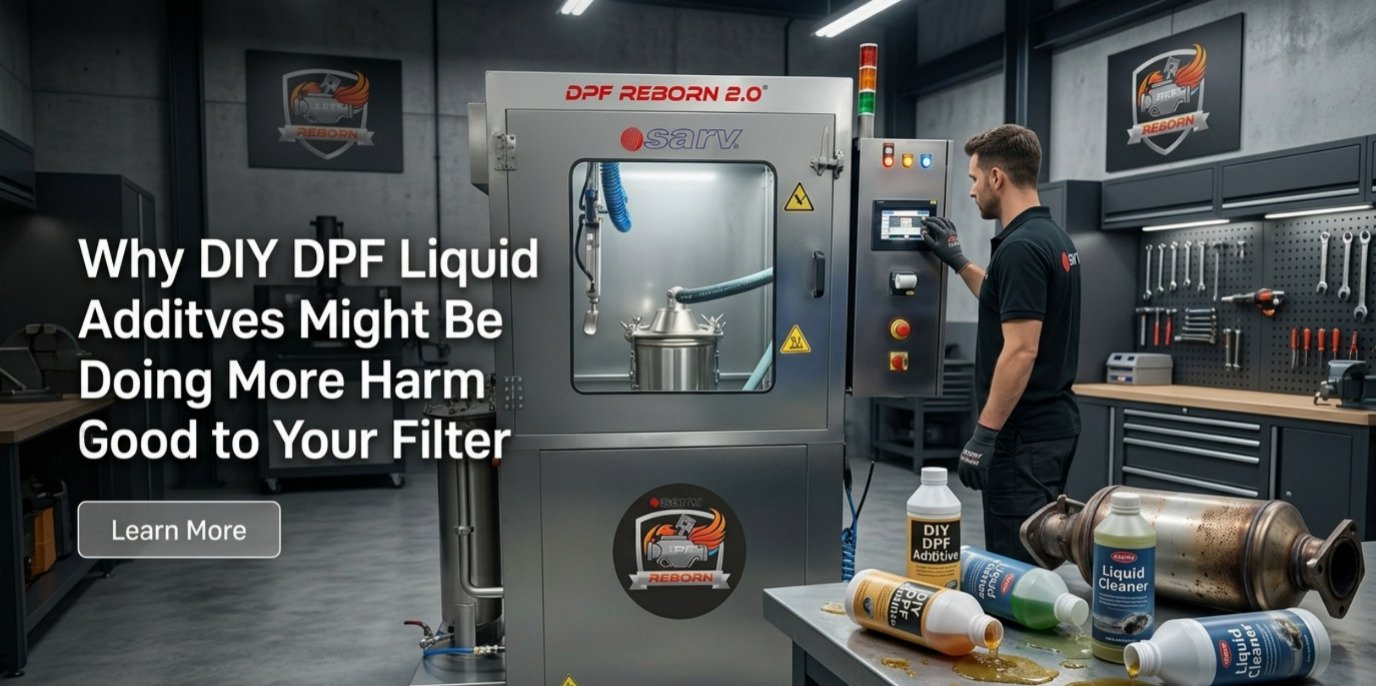
The most common quick fix is a bottle of off-the-shelf pour-in DPF cleaning solution. While chemical additives promise a fast, inexpensive reset, they often create bigger mechanical problems than they solve. Liquid additives change the chemical burning point of soot, which can lead to thermal stress, cracking, or complete filter failure. To properly restore exhaust flow without damaging internal substrates, professional service centers rely on an industrial DPF cleaning machine.
Understanding how DPFs operate, why liquid additives fail, and why specialized machinery is necessary will help you make the right choice for your vehicle or fleet maintenance.
Understanding DPF Blocking: Soot vs. Ash
To understand why a pour-in DPF cleaner fails, you must first understand what is clogging your filter. A DPF traps two types of waste material:
- Soot: Carbon particles produced during fuel combustion. Soot is flammable and can be burnt off during passive or active regeneration when exhaust temperatures reach $550^\circ\text{C}$ to $600^\circ\text{C}$.
- Incombustible Ash: Non-flammable metallic residue originating from engine oil additives, wear metals, and trace elements in diesel fuel.
Why Regeneration Cannot Remove Ash
Regeneration only burns away soot. It turns carbon into carbon dioxide ($CO_2$), leaving behind fine incombustible ash. Over tens of thousands of kilometers, this ash packs tightly into the honeycomb channels of the ceramic filter.
Because ash does not burn, no amount of heat—and no chemical DPF cleaning additive—can convert it into gas. When ash build-up creates high backpressure, physical removal through fluid washing or pneumatic purging is the only safe solution.
How DIY DPF Liquid Additives Work (And Why They Fail)
Pour-in additives are usually liquid chemical catalysts (often containing cerium oxide or iron oxide) poured directly into the fuel tank.
The Mechanism Behind Fuel Additives
These chemicals blend with diesel fuel and lower the ignition temperature of soot from approximately $600^\circ\text{C}$ down to $350^\circ\text{C}$–$400^\circ\text{C}$. The goal is to allow the filter to burn off soot during normal city driving without requiring high-speed highway temperatures.
The Hidden Hazards of Chemical Additives
While lowering the soot burn temperature sounds ideal on paper, it introduces several severe operational risks:
- Extreme Thermal Shock and Meltdown: When a heavily loaded filter undergoes accelerated burning triggered by additives, the internal temperature can spike uncontrollably beyond $1000^\circ\text{C}$. This extreme heat melts or cracks the silicon carbide or cordierite ceramic honeycomb structure inside the filter housing.
- Chemical Ash Accumulation: Fuel additives do not burn completely. The metallic catalysts in these solutions turn into additional ash residue, accelerating the physical blockage of the filter channels.
- Corrosion of Precious Metals: Many modern filters use platinum-group metals as catalytic coatings. Harsh liquid additives can strip or poison these coatings, permanently disabling the filter’s chemical catalytic capabilities.
- Sensors Damage: Chemical residues wash downstream, coating Differential Pressure Sensors and Exhaust Gas Temperature (EGT) sensors, leading to incorrect ECU readings and false fault codes.
Direct Spray Cleaners: A Temporary Mirage
Another common DIY method involves spraying a foaming DPF cleaning solution directly into the filter through the pressure sensor port while the filter remains attached to the exhaust system.
Although this may temporarily dissolve soft soot near the entry point, it presents distinct mechanical hazards:
- Soot Sludge Formation: The chemical liquid mixes with dry soot to form a thick, tar-like slurry. Instead of exiting through the tailpipe, this sludge settles in the lower cells of the filter, hardening once dry.
- Hydro-Lock Risks: Excess liquid pooled in the exhaust line can create excessive backpressure or enter turbocharger housings, causing turbo lag or seal failures.
- Incomplete Removal: Direct spray cannot reach the deep internal channels where high-density ash resides.
Internal Link Suggestion: [Read our detailed guide on how high backpressure damages your turbocharger and fuel economy → Insert Link Here]
Why Professional DPF Machine Cleaning is the Superior Solution
To safely restore a DPF to near-factory condition (up to 98% clean), the filter must be removed from the vehicle and cleaned using specialized equipment.
An advanced DPF cleaning machine utilizes a closed-loop pneumatic and hydraulic process to wash out ash and soot without damaging the catalytic substrate.
[Vehicle DPF Removal] ➔ [Initial Backpressure & Flow Test] ➔ [Dual-Hydro-Pneumatic Flushing] ➔ [Hot Air Drying Cycle] ➔ [Final Flow Verification]
Key Advantages of Machine-Based Cleaning
- Bi-Directional Flushing: Industrial machinery pumps water mixed with specialized, non-corrosive eco-friendly detergents through the filter in both forward and reverse directions. This hydraulic force dislodges compacted ash that chemical additives cannot touch.
- Controlled Pneumatic Air Pulses: High-pressure air pulses create a cavitation effect in the fluid, breaking down hardened ash deposits without subjecting the ceramic substrate to thermal shock.
- Complete Moisture Removal: After washing, the machine runs a dedicated drying cycle using heated air. Installing a wet DPF on a vehicle causes immediate soot clumping and premature blocking; automated machine drying prevents this issue completely.
- Verified Flow Dynamics: Modern equipment tests backpressure in millibars (mbar) before and after the process. This provides measurable proof of flow restoration.
DPF Maintenance Landscape in India
Commercial and passenger vehicles in India operate under unique challenges due to heavy traffic stop-and-go driving, high ambient dust levels, and varying fuel quality. With strict BS6 emission norms now enforced nationwide, DPF issues have become significantly more common.
Businesses, fleet managers, and service workshops across the country are rapidly moving away from temporary chemical sprays toward high-capacity machinery. Installing a dedicated DPF cleaning machine in india allows commercial garages to provide reliable, long-term filter restoration rather than short-term fixes.
For fleet operators, investing in periodic pneumatic-hydraulic machine cleaning extends engine life, reduces fuel consumption, and prevents expensive replacement costs.
Comparison: DIY Chemical Additives vs. Professional Machine Cleaning
| Feature / Metric | DIY Liquid Additives | Professional Machine Cleaning |
| Primary Target | Soft surface soot only | Compacted ash and soot |
| Ash Removal Capacity | 0% (Cannot remove ash) | 95% – 98% ash removal |
| Risk of Ceramic Thermal Damage | High (Uncontrolled burn temperature) | Zero (No thermal shock) |
| Impact on Sensors | Potential sensor fouling | Sensors cleaned separately |
| Post-Clean Flow Verification | None (Trial and error) | Precise backpressure testing (mbar) |
| Long-Term Reliability | Short-term (Days to weeks) | Long-term (Tens of thousands of km) |
How to Prevent DPF Blockages Naturally
While professional cleaning is required once ash accumulates, you can minimize premature soot loading by adopting proper maintenance practices:
- Use Low-SAPS Engine Oil: Low-SAPS (Sulphated Ash, Phosphorus, and Sulfur) engine oils are specifically formulated to reduce non-combustible ash generation in diesel engines.
- Maintain the Engine Air Intake: Faulty Mass Air Flow (MAF) sensors or clogged air filters cause an incorrect air-to-fuel ratio, leading to excessive black soot creation.
- Address Fuel Injector Leaks: Dripping injectors cause incomplete combustion, coating the DPF in raw fuel and sticky soot.
- Complete Highway Runs: Allow your vehicle to perform passive regeneration by driving at sustained highway speeds ($2000+$ RPM) for 20–30 minutes every few weeks.
Learn more :
Ministry of Road Transport and Highways (MoRTH)]
Final Thoughts
Relying on a cheap pour-in DPF cleaning solution might offer a temporary warning light reset, but it ultimately accelerates filter degradation by adding chemical ash and risking ceramic melting. When soot and ash choke your diesel particulate filter, physical, bi-directionally verified cleaning is the only technically sound method to restore exhaust performance.
By opting for specialized machine-based restoration, you protect your engine from excessive backpressure, avoid costly filter replacements, and ensure full compliance with emission standards.
Is your vehicle experiencing high fuel consumption or frequent DPF warning lights?
Stop risking your engine with harsh liquid additives! At Dpfcleanindia, we use state-of-the-art DPF cleaning machine technology to safely flush out 98% of trapped ash and soot—restoring your engine’s power and efficiency.
👉 Contact Our Experts for a Free Backpressure Consultation
FAQs