
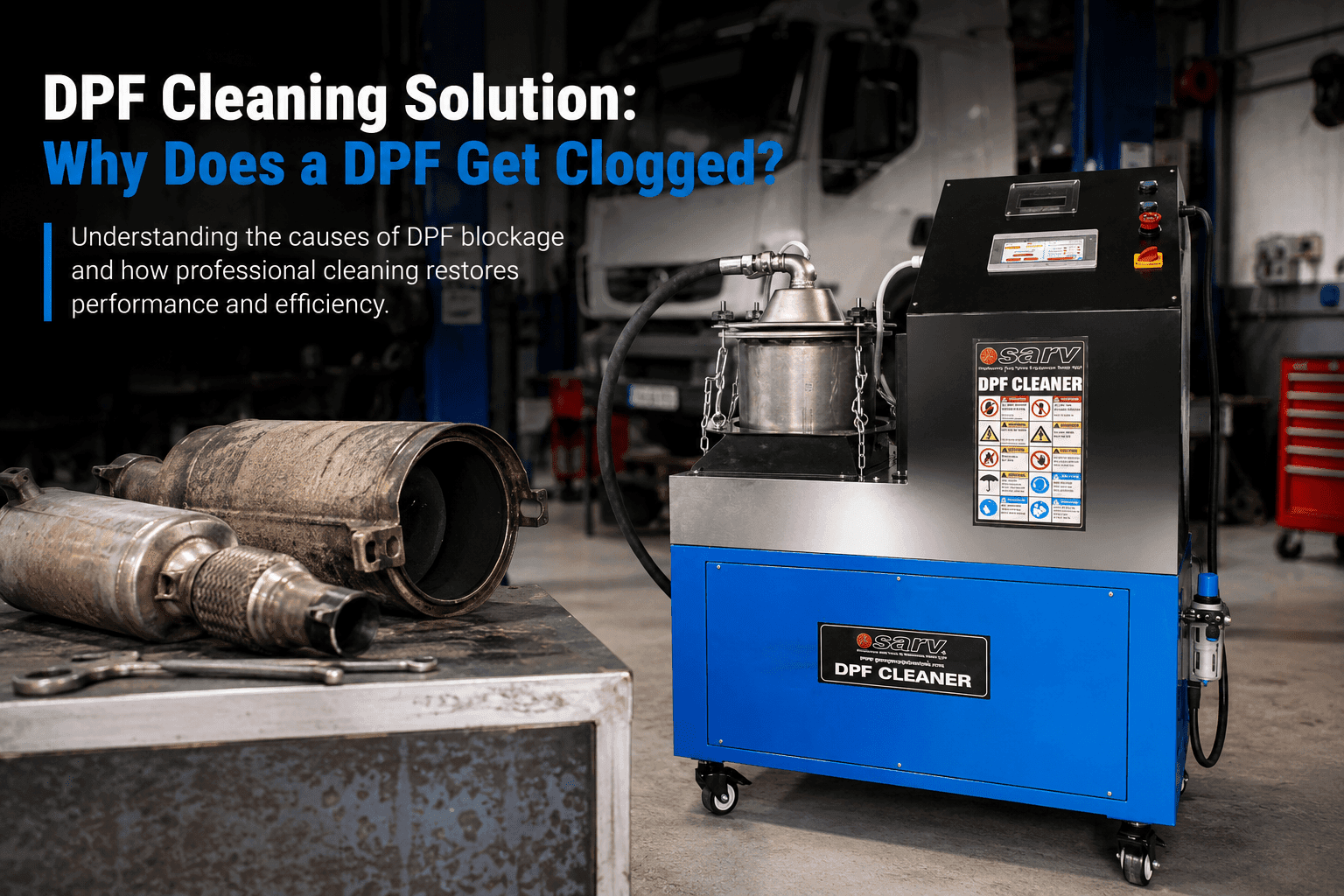
Modern diesel vehicles are designed to meet strict emission standards, and one of the most important components responsible for reducing harmful emissions is the Diesel Particulate Filter (DPF). However, many vehicle owners and workshop operators frequently face DPF blockage issues that affect performance, fuel economy, and engine reliability.
A professional DPF cleaning solution is often the most effective way to restore a clogged filter and avoid expensive replacements. Understanding why a DPF gets clogged can help vehicle owners take preventive measures and reduce maintenance costs.
In this guide, we explain the simple causes of DPF blockage, warning signs to watch for, and how a modern DPF cleaning machine can help restore filter efficiency.
What Is a DPF and Why Is It Important?
A Diesel Particulate Filter (DPF) is a critical component of a diesel vehicle’s exhaust after-treatment system. It is designed to capture and store soot particles (particulate matter) produced during the diesel combustion process before they are released into the atmosphere.
Modern diesel engines generate microscopic carbon particles during combustion. Without a DPF, these particles would exit through the exhaust system and contribute to air pollution. To prevent this, the DPF uses a specially engineered honeycomb ceramic structure with thousands of small channels that trap soot while allowing exhaust gases to flow through.
The DPF cleaning solution plays a vital role in helping diesel vehicles comply with BS6, Euro 6, and other global emission standards. By reducing particulate emissions, it helps improve air quality and minimizes the environmental impact of diesel-powered vehicles.
Key Functions of a DPF cleaning solution
- Captures harmful soot and particulate matter from exhaust gases
- Reduces vehicle emissions and environmental pollution
- Supports compliance with BS6 and international emission regulations
- Helps maintain efficient engine performance
- Contributes to cleaner and more sustainable diesel vehicle operation
How Does a DPF Become Full?
As the vehicle operates, soot continuously accumulates inside the filter. Under normal driving conditions, the engine initiates a process called DPF regeneration, where high exhaust temperatures burn the trapped soot into ash.
However, if regeneration does not occur effectively due to frequent short trips, low-speed driving, poor engine performance, or excessive soot production, the filter gradually becomes restricted. Over time, this restriction increases exhaust backpressure, reduces engine efficiency, lowers fuel economy, and may trigger DPF warning lights on the dashboard.
If the blockage becomes severe, professional cleaning using a DPF cleaning solution and an advanced DPF cleaning machine may be required to restore the filter’s performance and avoid costly replacement.
How Does a DPF Cleaning Solution Normally Clean Itself?
Most modern diesel vehicles perform a process known as regeneration.
During regeneration for DPF cleaning solution :
- The exhaust temperature increases.
- Collected soot burns away.
- The filter regains airflow capacity.
There are three main types of regeneration in DPF Cleaning Solution –
1. Passive Regeneration
In DPF cleaning solution passive regeneration occurs naturally when the vehicle is driven under conditions that generate sufficiently high exhaust temperatures, typically between 350°C and 500°C.
During long highway journeys or continuous high-load driving, the exhaust gases become hot enough to oxidize trapped soot particles without any intervention from the engine management system.
In this process:
- Exhaust gas temperature remains consistently high.
- Oxygen and nitrogen dioxide (NO₂) present in the exhaust help oxidize soot.
- Soot particles gradually burn away while the vehicle is operating normally.
- No warning lights or driver action are required.
Passive regeneration is considered the most efficient and fuel-friendly regeneration method because it occurs automatically during normal vehicle operation in DPF cleaning solution.
Common in:
- Long-haul trucks
- Highway-driven commercial vehicles
- Fleet vehicles operating under constant load
2. Active Regeneration
When the Engine Control Unit (ECU) detects excessive soot accumulation and passive regeneration has not occurred sufficiently, it initiates active regeneration in DPF cleaning solution.
During active regeneration, the ECU deliberately increases exhaust gas temperature to approximately 550°C–650°C by modifying engine operating parameters.
This may involve:
- Additional fuel injection during the exhaust stroke
- Increased engine load
- Adjustments to turbocharger operation
- Changes in EGR (Exhaust Gas Recirculation) strategy
These actions raise the DPF temperature high enough to burn accumulated soot.
During active regeneration:
- The driver may notice increased fuel consumption.
- Engine idle speed may rise slightly.
- Cooling fans may continue running after the engine is switched off.
- Exhaust temperature increases significantly.
If active regeneration completes successfully, the soot load decreases and normal DPF operation resumes.
Common in:
- City-operated trucks
- Delivery vehicles
- Passenger diesel vehicles
- Vehicles experiencing mixed driving conditions
3. Forced Regeneration
Forced regeneration becomes necessary when soot accumulation exceeds safe operating limits and both passive and active regeneration have failed.
In this situation, the DPF cleaning solution becomes heavily restricted, causing excessive exhaust backpressure and triggering warning lights or limp mode.
A technician performs forced regeneration using a diagnostic scan tool connected to the vehicle’s ECU.
During forced regeneration:
- The vehicle is stationary.
- Diagnostic equipment commands the ECU to initiate regeneration.
- Exhaust temperatures may exceed 600°C.
- The engine operates under controlled conditions while soot is burned from the filter.
However, if the DPF is severely blocked with soot, ash, oil contamination, or unburned residues, forced regeneration may not be effective.
In such cases, professional cleaning using a DPF cleaning solution and an advanced DPF cleaning machine is required to restore filter performance.
Common signs that forced regeneration may be needed:
- DPF warning light remains on
- Loss of engine power
- Reduced fuel efficiency
- Increased exhaust backpressure
- Frequent regeneration failures
For heavily contaminated filters, professional off-vehicle cleaning often provides better results than repeated forced regeneration attempts.
When these regeneration cycles do not occur effectively, the DPF starts becoming blocked.
1. Frequent Short Trips for DPF Cleaning Solution
One of the most common causes of DPF blockage is frequent short-distance driving.
Many city vehicles travel only a few kilometers at a time. During these short trips:
- Engine temperatures remain low.
- Exhaust temperatures fail to reach regeneration levels.
- Soot accumulates continuously.
As a result, the DPF becomes increasingly restricted.
Example
A delivery vehicle operating only within city limits may experience DPF clogging much faster than a truck traveling on highways.
2. Low-Speed Driving Conditions
Continuous low-speed driving creates similar challenges.
Vehicles that spend most of their time in:
- Heavy traffic
- Urban roads
- Stop-and-go conditions
often fail to generate sufficient exhaust heat.
Without proper heat, regeneration cycles become ineffective, causing soot accumulation inside the filter.
3. Ignoring DPF Warning Lights
Modern vehicles provide early warnings when the DPF requires attention.
Unfortunately, many drivers ignore:
- DPF warning lights
- Check engine lights
- Regeneration requests
Ignoring these warnings can transform a minor blockage into a severe restriction requiring professional DPF cleaning.
The earlier a problem is addressed, the lower the repair cost.
4. Poor Fuel Quality
Fuel quality directly affects soot production.
Low-quality diesel can lead to:
- Increased carbon deposits
- Incomplete combustion
- Excess particulate generation
This additional soot overloads the DPF and shortens cleaning intervals.
Using high-quality fuel helps maintain cleaner combustion and supports effective regeneration.
5. Faulty Fuel Injectors
Fuel injectors are responsible for delivering precise amounts of diesel into the combustion chamber.
When injectors become worn or damaged:
- Excess fuel may enter the engine.
- Combustion efficiency decreases.
- Soot production increases dramatically.
This excessive soot quickly fills the DPF and accelerates clogging.
Regular injector inspections can prevent unnecessary DPF problems.
6. Engine Oil Contamination
Not all DPF blockage comes from soot.
Engine oil additives can create ash deposits inside the filter.
Unlike soot, ash cannot be removed through normal regeneration.
Over time, ash accumulation reduces filter capacity and airflow.
Professional cleaning using a specialized DPF cleaner and advanced cleaning equipment becomes necessary to restore performance.
7. Turbocharger Problems
A malfunctioning turbocharger can significantly increase soot output.
Common turbo issues include:
- Oil leaks
- Reduced boost pressure
- Damaged turbine components
These conditions affect combustion efficiency and contribute to excessive particulate generation.
The result is faster DPF saturation and frequent warning lights.
8. Faulty Sensors
Modern DPF systems rely on several sensors, including:
- Differential pressure sensors
- Temperature sensors
- Oxygen sensors
If these sensors fail:
- Regeneration may not activate.
- Incorrect readings may occur.
- DPF performance can deteriorate rapidly.
Sensor inspection should always be part of DPF diagnostics.
BS6 Emission Standards Information for DPF Cleaning Solution
DPF Cleaning Solution – Restore Performance. Reduce Costs. Improve Profitability.
Whether you’re a workshop owner, fleet operator, or automotive service provider, DPF Clean India offers advanced DPF cleaning solutions designed to remove soot buildup, improve fuel efficiency, and extend filter life.
Explore our range of DPF cleaning machines and find the right solution for your business.